


In the latest NAHB/Wells Fargo Housing Market Index (HMI) released on March 16, 2026, builder confidence in the single-family housing market edged up slightly to 38 — a one-point increase from February's reading of 37. While this modest boost offers a glimmer of optimism, the index remains well below the 50 benchmark that signals a healthy market, marking the 23rd consecutive month in negative territory.Economists surveyed by Reuters had anticipated the index would hold steady at 37, making the small gain a mild positive surprise for the homebuilding sector.
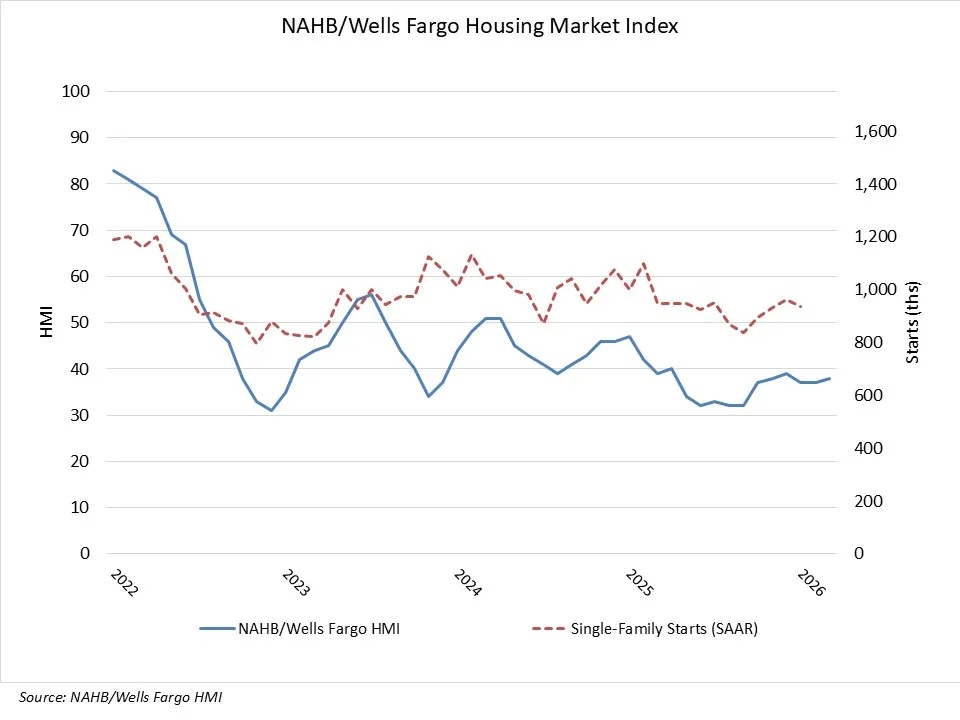
Factors Driving the Slight ImprovementThe uptick appears linked to earlier reductions in mortgage rates following directives from the Trump administration for government-sponsored enterprises Fannie Mae and Freddie Mac to ramp up purchases of mortgage-backed securities. Lower rates temporarily improved affordability and buyer interest in new homes.However, recent shifts have reversed some of that progress. Escalating geopolitical tensions, including the U.S.-Israeli conflict with Iran, have driven up oil prices and fueled inflation fears. This has pushed U.S. Treasury yields higher, with mortgage rates closely tracking the 10-year Treasury yield. As a result, many potential buyers remain sidelined, waiting for more favorable borrowing conditions amid broader economic uncertainty.Persistent Headwinds for HomebuildersNAHB Chairman Bill Owens highlighted key ongoing pressures:
“Many buyers remain on the fence waiting for lower interest rates and due to economic uncertainty. Builders are facing elevated land, labor and construction costs and nearly two-thirds continue to offer sales incentives in a bid to firm up the market.”Builders report continued challenges from rising construction expenses, labor shortages, and supply chain issues. The percentage of builders offering price cuts ticked up slightly to 37% (from 36% in February), with average reductions holding at 6%. Sales incentive usage dipped marginally to 64% (still above 60% for the 13th straight month) as the industry works to clear excess new home inventory.Sub-Index Breakdown Shows Mixed Signals
“Many buyers remain on the fence waiting for lower interest rates and due to economic uncertainty. Builders are facing elevated land, labor and construction costs and nearly two-thirds continue to offer sales incentives in a bid to firm up the market.”Builders report continued challenges from rising construction expenses, labor shortages, and supply chain issues. The percentage of builders offering price cuts ticked up slightly to 37% (from 36% in February), with average reductions holding at 6%. Sales incentive usage dipped marginally to 64% (still above 60% for the 13th straight month) as the industry works to clear excess new home inventory.Sub-Index Breakdown Shows Mixed Signals
- Current sales conditions rose one point to 42.
- Future sales expectations (next six months) climbed two points to 49 — approaching the breakeven level.
- Prospective buyer traffic improved three points to 25, indicating a slight uptick in interest despite affordability barriers.